




Amethyst Buying Guide: How to Choose Your Perfect Amethyst
Most people come to us with the same question: which one is right for me? It’s a reasonable thing to wonder. Amethyst spans an enormous range — in colour, size, form, and intention — and the differences aren’t always obvious at first glance. This guide covers what actually matters when choosing a piece: the quality signals worth knowing, the questions worth asking, and the decisions that depend entirely on you.
In this guide:
- what actually makes one piece more desirable than another
- how amethyst forms, and why it matters for what you buy
- quality signals: colour, clarity, shape, size, and origin
- which form suits your space
- how to care for a piece so it stays beautiful
Why Choose Amethyst? Beauty, Mystery, and Meaning
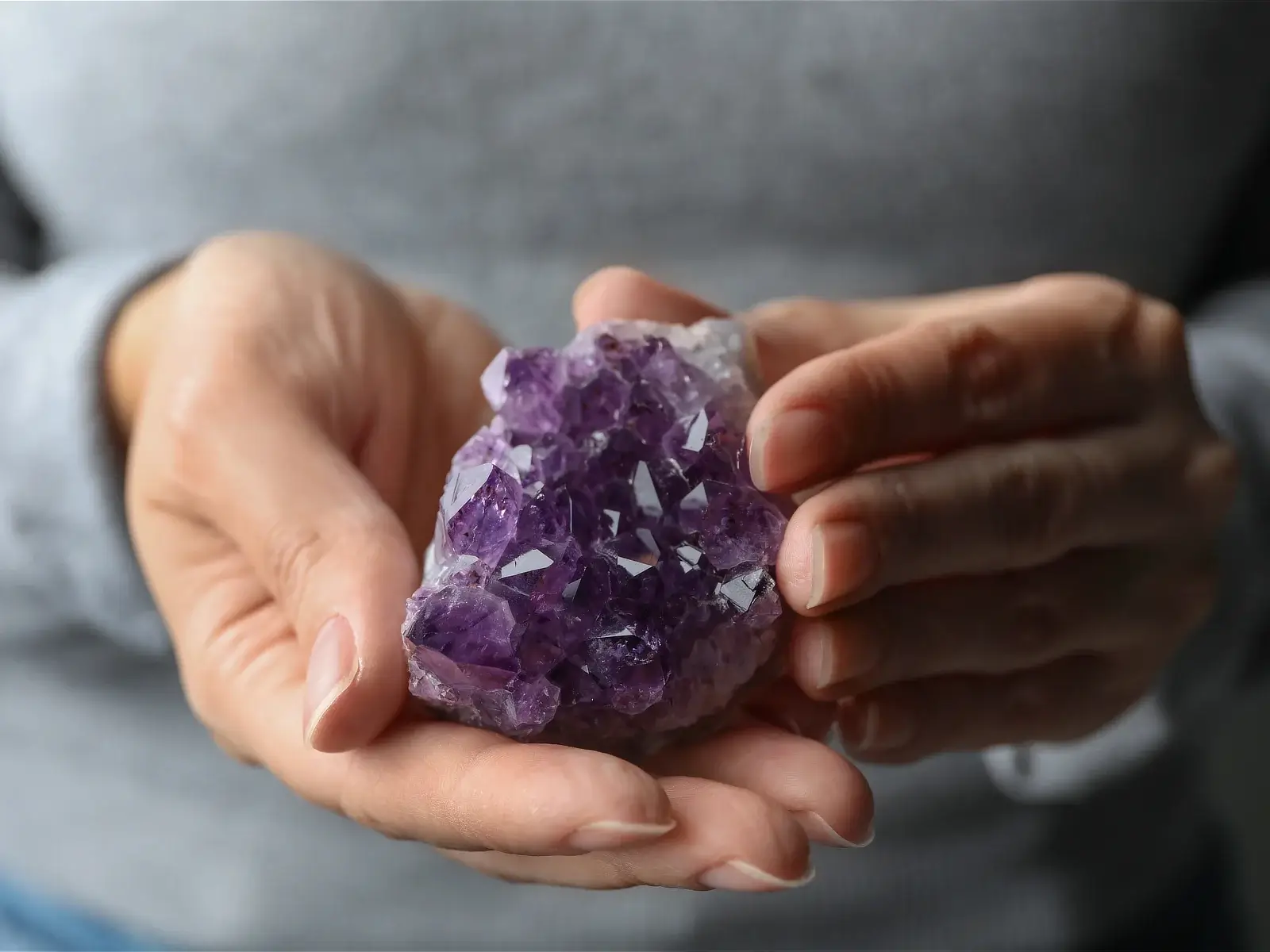
There’s a reason amethyst keeps appearing across centuries of human history — in Roman drinking vessels, medieval bishop’s rings, Egyptian burial chambers. It’s not purely because purple was rare or expensive. There’s something about the colour itself, the way it sits between calm and intensity, that people have always responded to.
The Greeks believed it prevented intoxication (they were wrong, but the association with clear-headedness stuck). Today, most people who buy amethyst aren’t thinking about ancient myths. They just want something beautiful in their home that also feels special.
From Earth’s Depths to Your Home: How Amethyst Forms
Amethyst starts as an empty cavity in volcanic rock. Over anywhere from 1 to 10 million years, mineral-rich water seeps in. Quartz crystals form slowly on the walls, and if the conditions are right — iron present, natural radiation doing its work over an enormous stretch of time — the crystals turn purple.
That’s the short version. The longer version involves precise temperature gradients, groundwater chemistry, and geological processes that researchers are still working through.
The results are:
- hollow geodes lined with thousands of crystal points freestanding clusters that catch light from every angle
- freestanding clusters that catch light from every angle
From there, some pieces go to cutters who shape them into spheres, obelisks, and other forms. Others arrive exactly as they grew — just opened, cleaned, and mounted.
The piece that ends up on your desk could be 50 million years old. I find that genuinely hard to process, even now.
Understanding Amethyst Quality
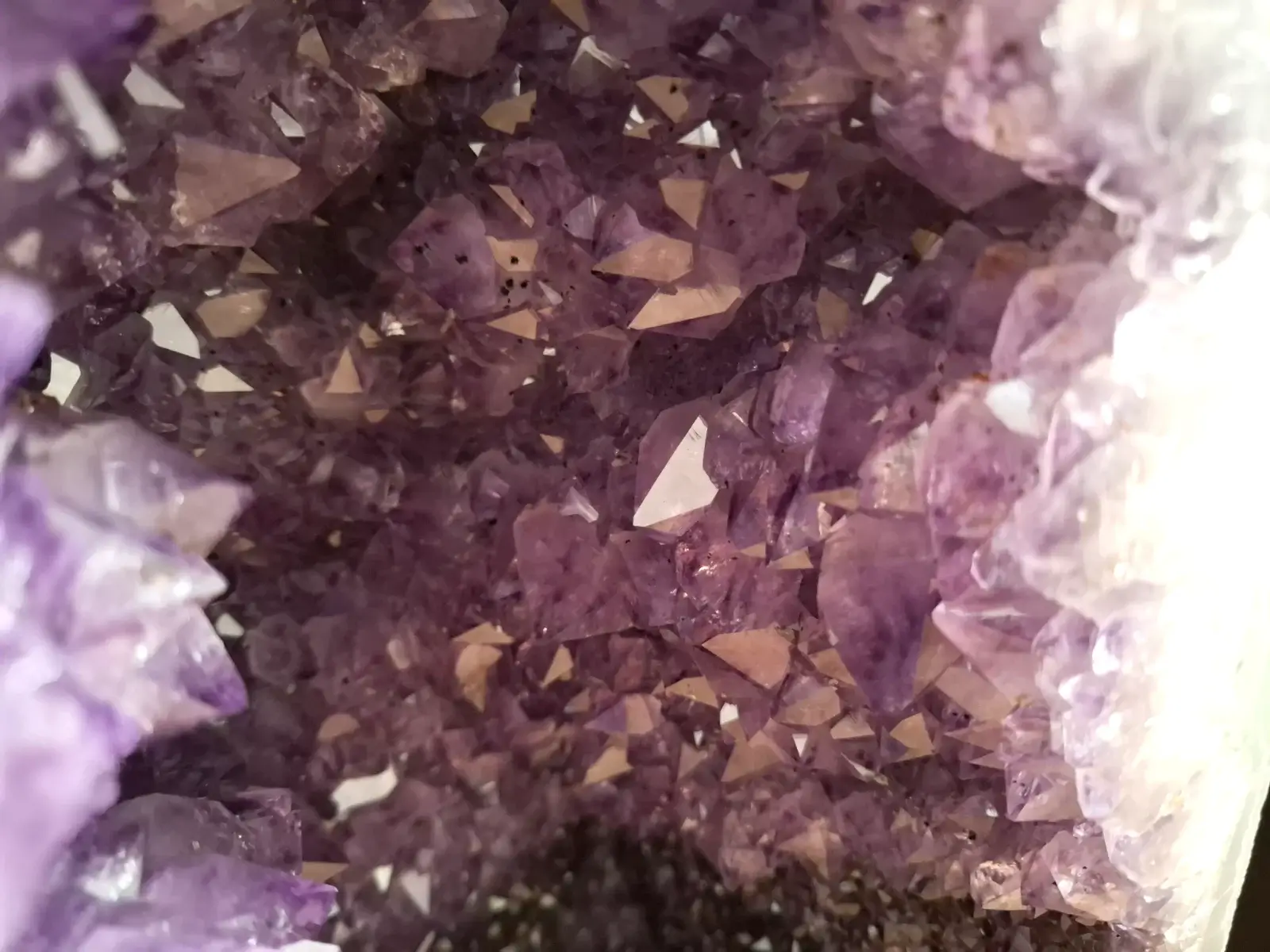
Six factors determine whether an amethyst is worth what it costs: colour, clarity, shape, size, origin, and authenticity. Understanding this takes maybe ten minutes. It’ll save you from buying something that looks impressive in a photo and disappoints in person.
At Saluxe, we consider each of these factors carefully when hand-selecting every piece.
1. Colour: The Purple Spectrum of Amethyst
Colour is usually the first thing you notice, and the most subjective part of choosing a stone. There’s no objectively correct shade of purple.
That said, a few principles hold:
- Deep, saturated purples — especially those with flashes of red or blue — are the most sought-after. Uruguayan stones tend to land here.
- Medium violet tones are great in most interiors. Less dramatic, but more versatile.
- Pale lilac can work beautifully in light-filled, minimal spaces — though at this end of the spectrum, be careful you’re not paying premium prices for a very light stone.
Hold the piece near a window if you can. The colour shifts in different light, and what looks vibrant under a warm bulb can look washed-out in daylight.
At Saluxe, we favour stones with depth and consistency — pieces that hold their colour across lighting conditions.
2. Clarity: From Eye-Clear to Natural Inclusions
Eye clarity means no distracting internal fractures, milky patches, or muddy zones when you look straight into the crystal.
- The best pieces are eye-clear — transparent through most of the crystal, with no haziness that disrupts the depth.
- Minor inclusions are fine. They’re natural, and they add character. What you want to avoid is a piece where clouding or cracking breaks the visual flow.
- Heavily fractured sections can also affect structural integrity — especially in larger pieces that will be moved or handled.
I’ll be honest: perfect clarity is rare at larger sizes. A one-metre geode with entirely eye-clear crystals throughout is exceptional. Most good pieces have some variation, and that’s normal.
Every piece at Saluxe is assessed for both visual clarity and structural stability before we list it.
3. Shape & Form: Geodes, Clusters, and More
Amethyst takes many forms. The right choice depends less on which is “best” and more on where the piece will live and which form speaks most to the buyer.
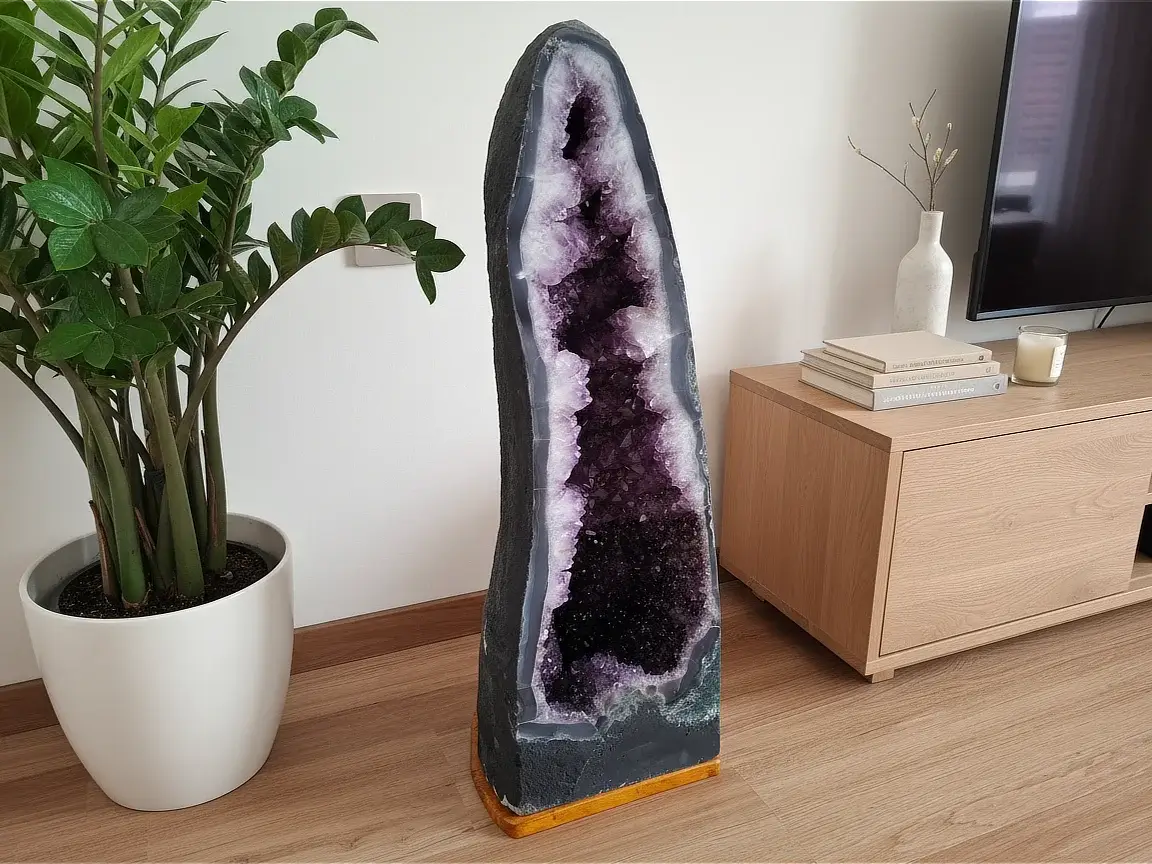
Geodes & cathedrals – Tall, naturally hollow formations lined with crystal points from base to tip. They have real presence. A good cathedral geode in a hallway or living room doesn’t just sit there — it defines the space. These are the pieces people stop to look at.
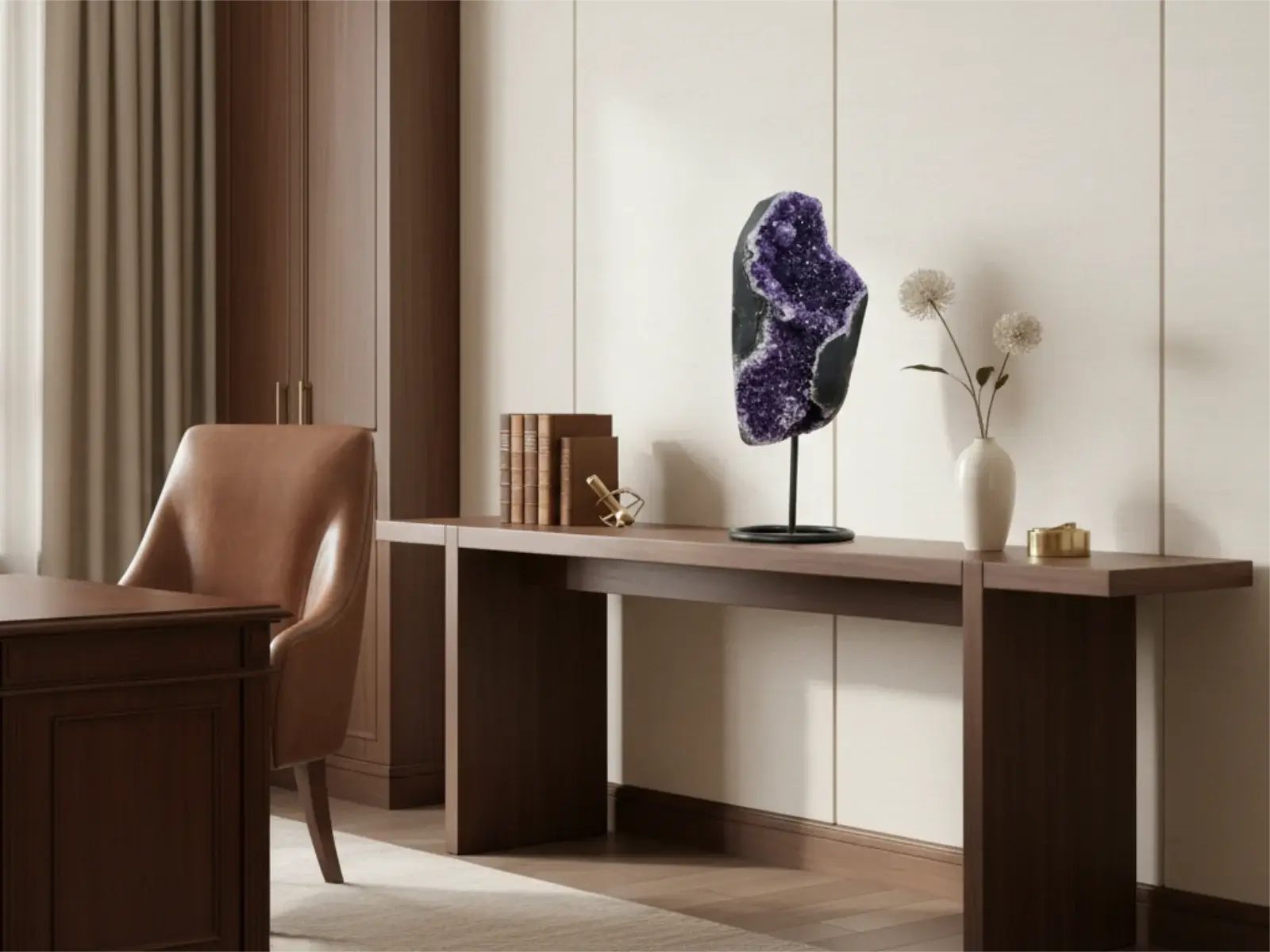
Amethysts on stands – A geode or cluster mounted on a custom stand, so it reads more like sculpture than raw mineral. Smaller pieces work on shelves and consoles. Larger ones can anchor a corner, sit beside a sofa, or hold their own against a sideboard. The stand changes how the stone is experienced — it’s presented, not just placed.
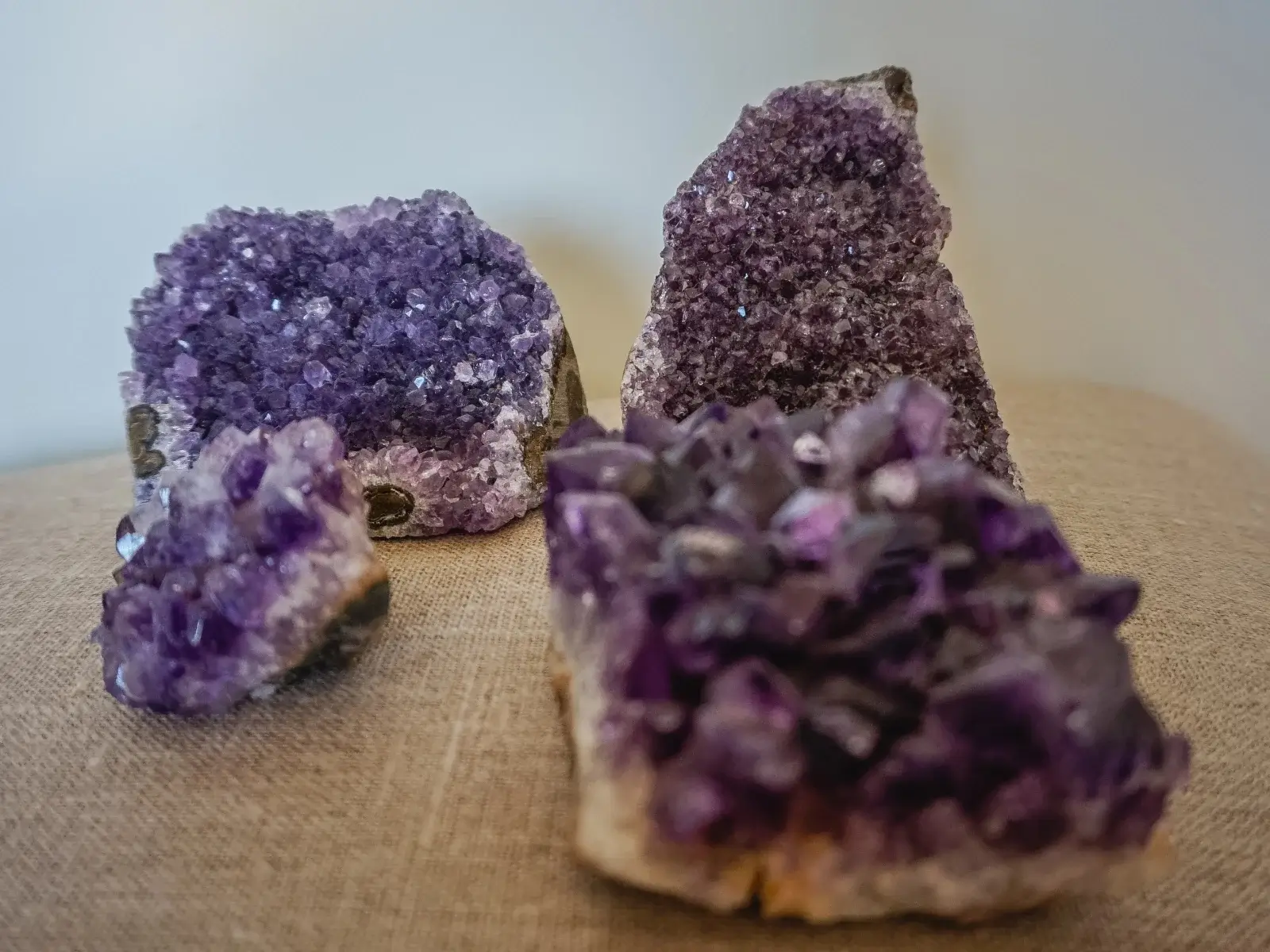
Clusters – Freestanding groups of crystal points, no base required. Textural and lively, good for shelves and tables where you want sparkle without weight. Less dramatic than a geode, but easier to place.
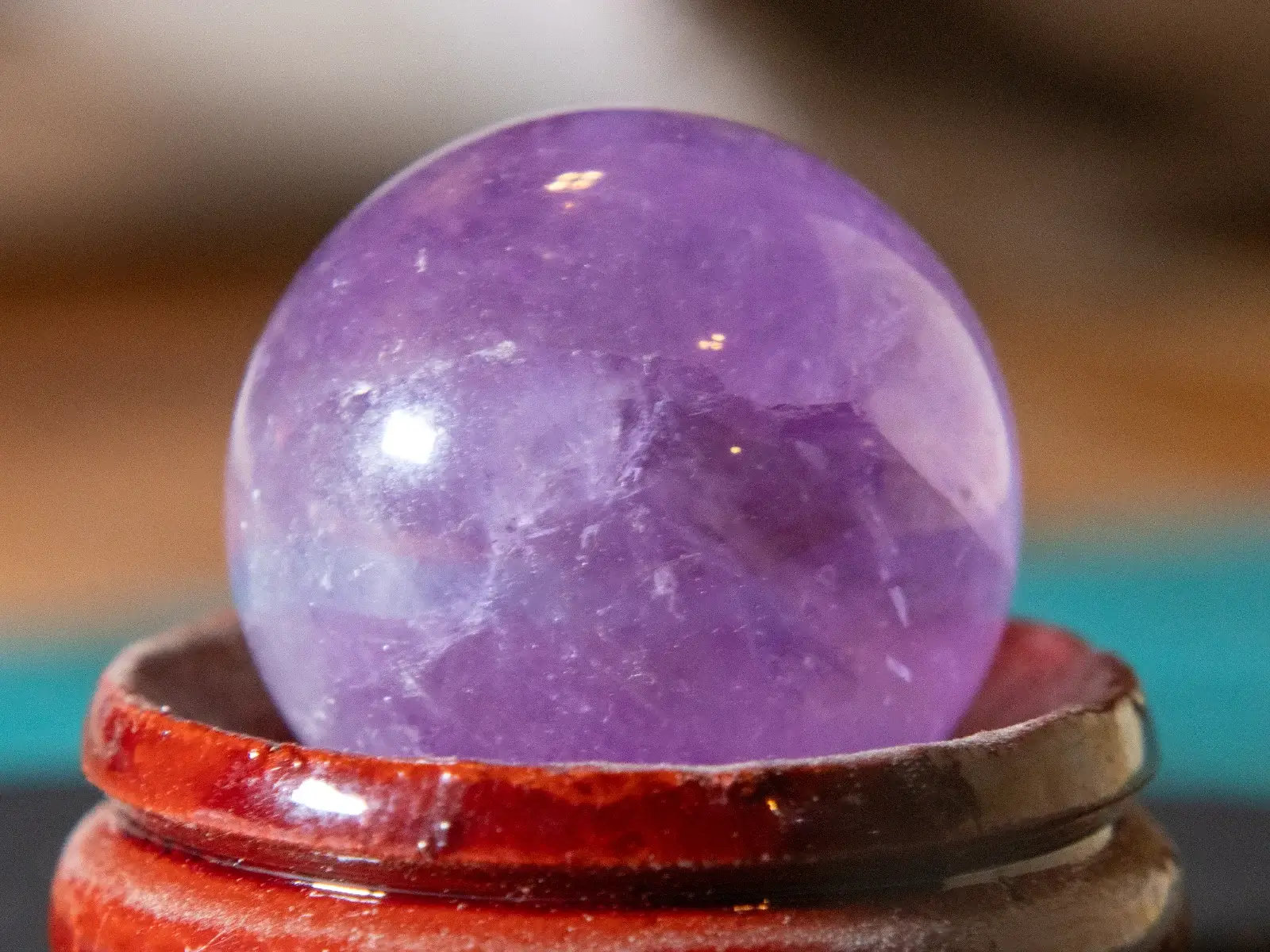
Spheres & obelisks – Polished forms cut from raw amethyst. They bring a different quality: deliberate, contemporary, refined. They sit well in curated displays or alongside modern design objects.
At Saluxe, we offer amethysts in a wide range of sizes and forms, and we are always expanding our collection with carefully selected pieces.
4. Size: Finding the Right Scale for Your Space
Size is where most people get it wrong — they underestimate how much space a piece needs to breathe, or they buy something too small for the room and it simply disappears.
- Large pieces (over a metre) need generous surroundings. Entry halls, open-plan living areas, high-ceilinged offices, hotel lobbies. In the right setting, they read like furniture or sculpture. In a crowded room, they just look oversized.
- Medium pieces are probably the most versatile. They work beside armchairs, near consoles, in corners, in reading nooks. Noticeable without taking over.
- Smaller pieces suit desks, shelves, and bedside tables. The key with small pieces is placement — they need to be easily visible, or they lose their impact entirely.
A useful rule: the more visually dominant the piece, the calmer everything around it should be. One strong amethyst in a neutral room is a composition. One strong amethyst in a busy room is just a problem.
5. Origin: Brazil, Uruguay, and Beyond
Where an amethyst comes from affects almost everything about it — colour depth, crystal size, formation shape, and price.
- Brazilian amethyst is the most abundant. Formations tend to be large, sometimes dramatically so, with lighter to medium violet tones and gentle colour variation throughout. If you want size and presence without the deepest colour, Brazil delivers.
- Uruguayan amethyst is different. Smaller formations, usually, but the colour is something else — a concentrated, saturated purple that darkens almost to black in low light. Clarity is typically high. Supply is tighter, which is reflected in the price.
- African deposits — Zambia and Namibia particularly — can produce vivid, distinctive stones with internal structures you don’t often see from South American material. Less common in the market, but worth knowing about.
Most of our collection at Saluxe comes from Brazil and Uruguay. Both produce excellent amethyst, with Brazilian pieces often forming larger geodes and Uruguayan stones known for their deep colour.
6. Authenticity & Ethical Sourcing
The amethyst market has its share of problems. Dyed stones, coated quartz, synthetic material, heavily irradiated specimens — all sold as natural amethyst, sometimes at prices that suggest otherwise.
The simplest protection is buying from someone whose sourcing you can actually verify.
At Saluxe, we are committed to:
- using only natural amethyst, never dyed or synthetic
- working with partners who prioritise responsible extraction and fair labour practices
- providing transparent information about each piece’s characteristics
If you ever have a question about a specific piece, ask us. We’d rather answer ten questions than have you unsure about something you’ve paid good money for.
Choosing the Right Amethyst for Your Needs
The quality questions above apply to everyone. What changes is why you’re buying and where the piece will live. Here’s how to think about it.
For Décor Enthusiasts & Interior Designers
Amethyst works as a design object when it’s treated like one — placed deliberately, not just displayed.
- Silhouette first. A tall, narrow geode reads differently than a wide, low cluster. Match the shape to the space: tall pieces for corners and entries, wider pieces for consoles and low furniture.
- Colour harmony. Deep purples sit naturally with warm neutrals — oak, brass, terracotta. Lighter lilacs work better against stone, pale grey, or white. Don’t fight the room’s palette.
- One strong piece. A single well-chosen geode does more for a room than five scattered smaller ones. Let it lead.
For décor-led choices, explore our Statement Pieces and Amethyst on Stand collections.
For Wellness & Spiritual Seekers
Amethyst’s association with calm and clarity isn’t modern. It goes back to Greek and Roman times, and it’s persisted across cultures for a reason. There’s something about the colour and the crystal structure that genuinely affects how a space feels.
If this is your primary motivation:
- Placement matters more than size. A cluster or sphere in a meditation space, a reading corner, or on a bedside table does more than a large piece in a room you rarely enter.
- Rounder, softer forms — clusters, spheres, gently curved geodes — tend to feel less imposing than tall cathedrals. The presence is quieter.
- Keep the surrounding space simple. The amethyst works best when it’s not competing.
Medium-sized pieces on stands tend to work well here — present enough to be noticed, calm enough to belong.
For Collectors
Collectors are looking for things that are genuinely hard to find: unusual colour balance, exceptional crystal terminations, remarkable formation density, or a silhouette that stands apart.
Key aspects to consider:
- Colour — deep violet with red or blue flashes is the benchmark. More saturated than the category average, more consistent throughout.
- Crystal quality — dense, even coverage with well-formed terminations. No large gaps, no broken points, no heavily damaged areas.
- Form — unusually tall, naturally symmetrical, or visually striking in some way that makes it stand out even in a room with other good pieces.
- Provenance — individually selected and documented, not pulled from bulk stock.
Most serious collectors build slowly — a small group of pieces that differ in origin, form, and character, rather than many similar stones.
Every piece at Saluxe is selected individually and documented. We treat nothing as interchangeable.
For Thoughtful Gifts
An amethyst makes a good gift precisely because it isn’t generic. It has weight — physical and otherwise. You’re not giving someone a candle or a throw pillow. You’re giving them something that will sit in their home for decades.
When gifting, think about:
- The recipient’s space — a bright, minimal apartment calls for something different than a warm, layered home. If you’re unsure, a medium-sized piece on a stand is versatile enough to work in most settings.
- Their lifestyle — would they appreciate a desk piece, or something more dramatic for the living room?
- The message you want to convey — amethyst has longstanding associations with calm, clarity, and protection. That’s not nothing, especially for someone going through a significant life moment.
Pairing the piece with a short note about where it came from and what it represents turns a beautiful object into something more.
Caring for Your Amethyst
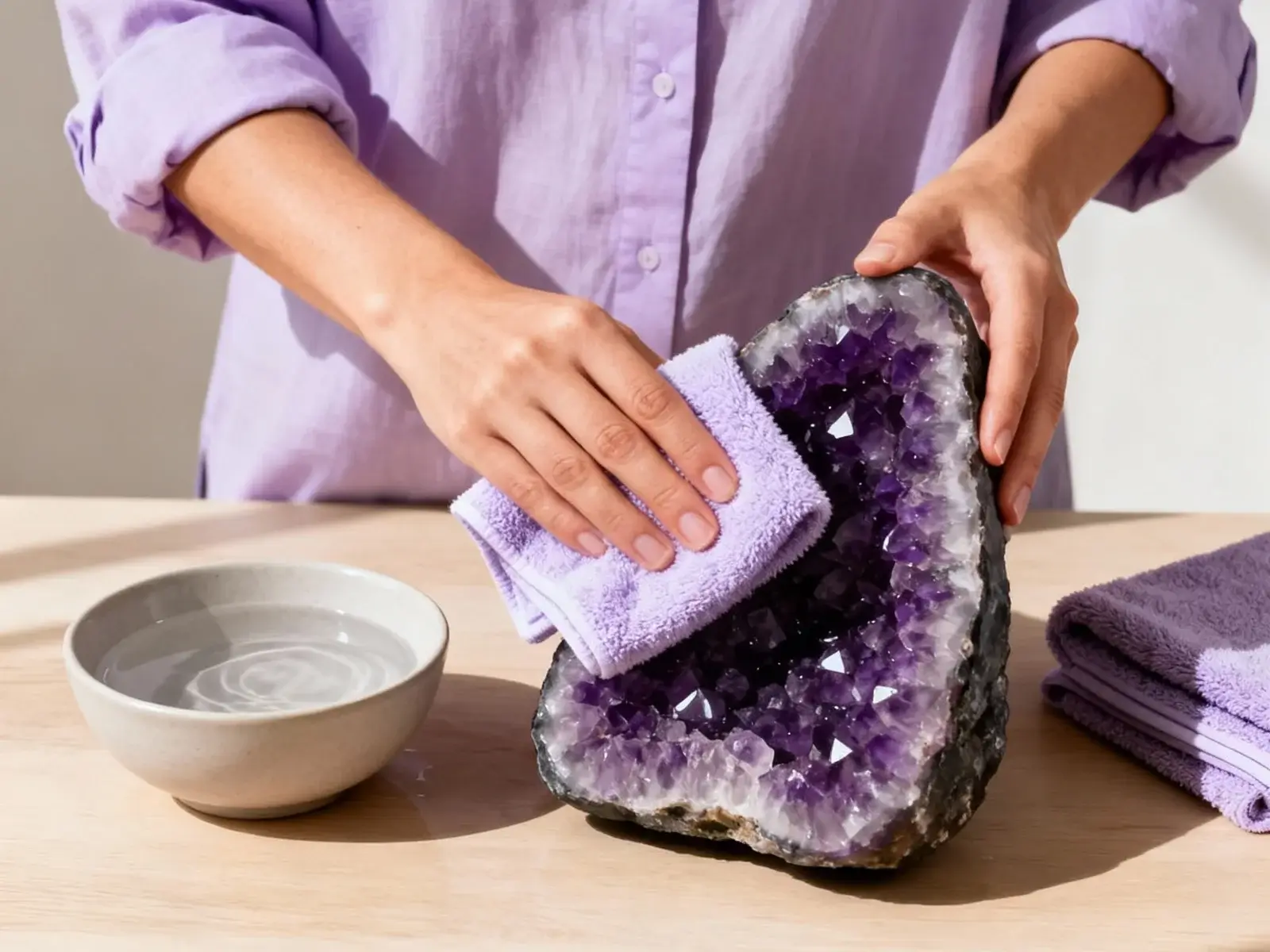
The good news: amethyst doesn’t ask much of you.
- Dust with a soft, dry cloth. That’s the main thing.
- Keep it out of direct sunlight for extended periods — UV exposure will fade the colour over time. Near a window is fine; in direct sun all day, less so.
- Move larger pieces carefully. They’re heavier than they look, and crystals can chip if knocked.
- Avoid harsh cleaning products. Water and a soft cloth handle most things.
- For metaphysical care, occasionally refresh your amethyst with simple rituals such as soft natural light, a few quiet breaths, or placing it near other cleansing crystals.
For a detailed care routine, read our full Amethyst Care Guide.
Experience the Beauty of Amethyst with Saluxe™
If you’ve read this far, you probably have a sense of what you’re looking for — or at least a better idea of the questions worth asking.
Every piece in our collection has been selected individually. Nothing goes on the site that we wouldn’t buy ourselves.
Browse our collections, or contact us for a personal recommendation. We’re straightforward about what a piece is and whether it’s right for you.
Editorial Note — To bring our stories and concepts to life, some images are occasionally artistically refined or digitally composed.