




Stories
What Is an Amethyst Geode? How to Choose One and What to Look For

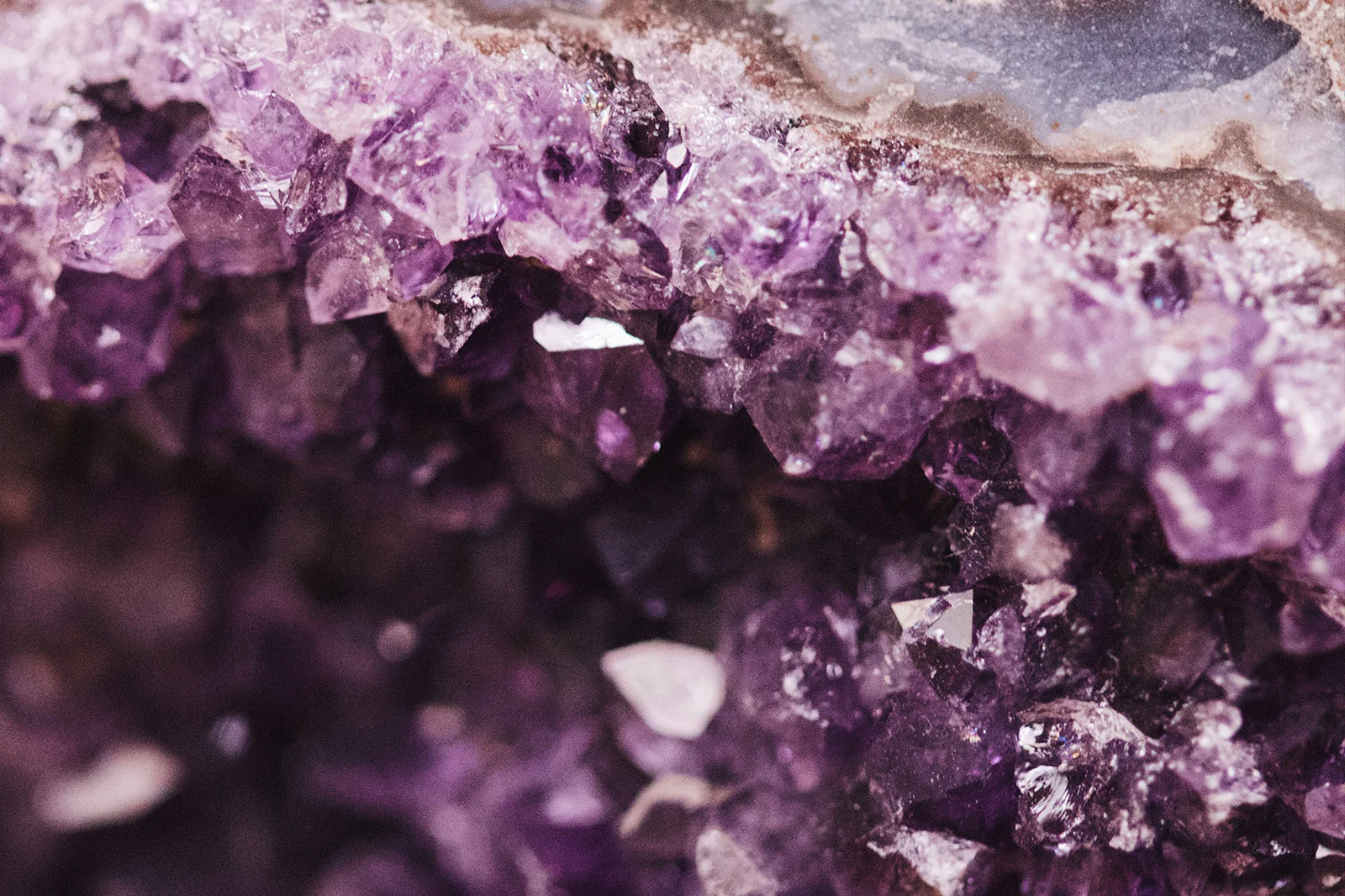
The first time I saw a cathedral geode opened, I actually stepped back. From the outside it looked like any other piece of rough volcanic rock — grey, heavy, unremarkable. Then you crack it, and inside is this glowing chamber of purple crystals, pointed and precise, growing toward the centre like they were reaching for each other. Something that took between 1 and 10 million years to form, and nobody saw it until that moment.
That contrast – ordinary outside, extraordinary inside – is what makes geodes unlike anything else you can put in a room.
An amethyst geode is a hollow stone lined with inward-growing amethyst crystals. It forms over geological time inside cavities in volcanic rock, as silica-rich water slowly deposits minerals and crystals begin to grow from the inside walls. Some geodes are compact and decorative, while others develop into tall cathedral-shaped statement pieces with a strong architectural presence.
If you’d like a broader introduction to amethyst – how to recognise quality, which types suit different spaces, how to care for it – our Amethyst Buying Guide covers all of that. This piece focuses specifically on geodes: what they are, how they form, what affects their quality, and how to choose one well.
How Amethyst Geodes Form
Amethyst geodes begin as hollow spaces inside volcanic rock, usually basalt. Over time, mineral-rich water enters these cavities and deposits layers of silica. As the process continues, quartz crystals grow inward from the cavity walls. When trace elements such as iron are present, and the stone is shaped by natural geological conditions over time, the quartz develops its purple amethyst colour.
This is part of why geodes feel so unusual in person. You’re not looking at a polished surface or a cut decorative material. You’re looking into a natural crystal chamber that formed slowly, in darkness, over millions of years.
Amethyst Geode vs Cluster vs Cathedral
These terms are often used loosely, but they do not mean exactly the same thing.
A geode is a hollow stone lined with crystals on the inside.
A cluster is usually more open, with crystals growing outward from a base rather than inside a cavity.
A cathedral is a tall, vertically cut type of geode with a narrow opening and a strong upright form. It is often chosen as a statement piece in interiors because it combines the depth of a geode with a sculptural silhouette.
Understanding the difference helps when you start browsing. Someone looking for a shelf piece may prefer a smaller geode or cluster, while someone furnishing a larger room may be drawn to a cathedral or a more substantial geode on stand.
What Makes an Amethyst Geode So Special?
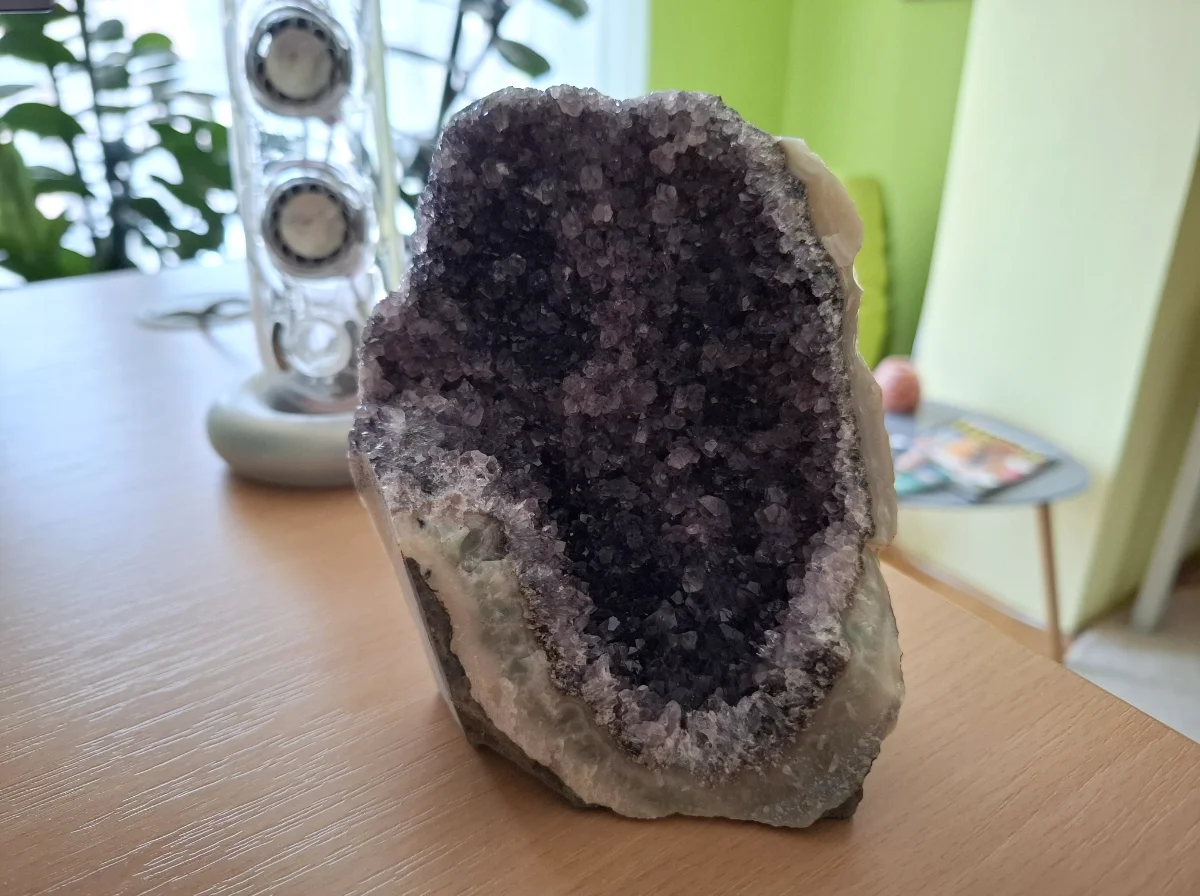
A few things set geodes apart from loose crystals or clusters, and they’re worth naming precisely.
- Contrast — The exterior is plain, often matte and grey. The interior is saturated, luminous, architectural. That gap between the two is where most of the emotional impact lives. It’s not decoration in the ordinary sense — it’s revelation.
- Real depth — Crystal points grow inward from the cavity walls, which means light doesn’t just reflect off the surface. It enters the piece. It travels into the crystal field and comes back out changed. You get different things at different times of day.
- Genuine individuality — No two geodes share the same colour gradient, crystal density, or silhouette. Two pieces from the same mine, cut in the same week, can look completely different. This isn’t marketing language. It’s geology.
- Presence without noise — A well-chosen geode holds attention without competing for it. It has weight. People often describe living with one as easier than they expected — it settles into a room rather than demanding the room adjust to it.
What Affects the Quality of an Amethyst Geode?
Not every geode has the same visual impact or long-term appeal. Quality usually comes down to a combination of colour, crystal structure, shape, and overall presence.
- Colour is often the first thing people notice. Some are pale and airy, others much deeper and more saturated. Neither is automatically better, but the strongest pieces tend to have colour that feels rich, natural, and visually resolved.
- Crystal quality matters just as much. Well-defined crystal points, good density, and a lively internal structure usually make a piece feel more substantial and more beautiful in changing light.
- Shape and opening also play a major role. A geode with a balanced silhouette and a well-proportioned crystal chamber will usually feel stronger in a room than one that is simply large.
- Origin can matter too, especially for buyers who are comparing many pieces. Certain sources are known for stronger saturation or a particular crystal character, although visual quality should still come first.
If you want a broader overview of what separates a stronger piece from an ordinary one, our Amethyst Buying Guide goes deeper into colour, origin, form, and overall selection criteria.
How to Choose an Amethyst Geode for Your Home
The best place to start is not size alone, but placement.
A tall cathedral geode works well as a focal point near a fireplace, console, or open corner, where its vertical form has room to breathe. Smaller geodes and geodes on stand are often better suited to shelves, sideboards, desks, and reading corners, where they can bring presence without overwhelming the space.
Then look at the specifics:
- the depth and tone of colour
- the density and sharpness of the crystals
- the width and shape of the opening
- the balance of the silhouette
- how the piece feels in relation to the room around it
The right geode is not always the darkest or the biggest. Often it is the one that feels resolved — visually, spatially, and emotionally.
For help checking whether a piece appears genuinely natural before you buy, see our guide to spotting real amethyst.
Geodes in Interior Spaces
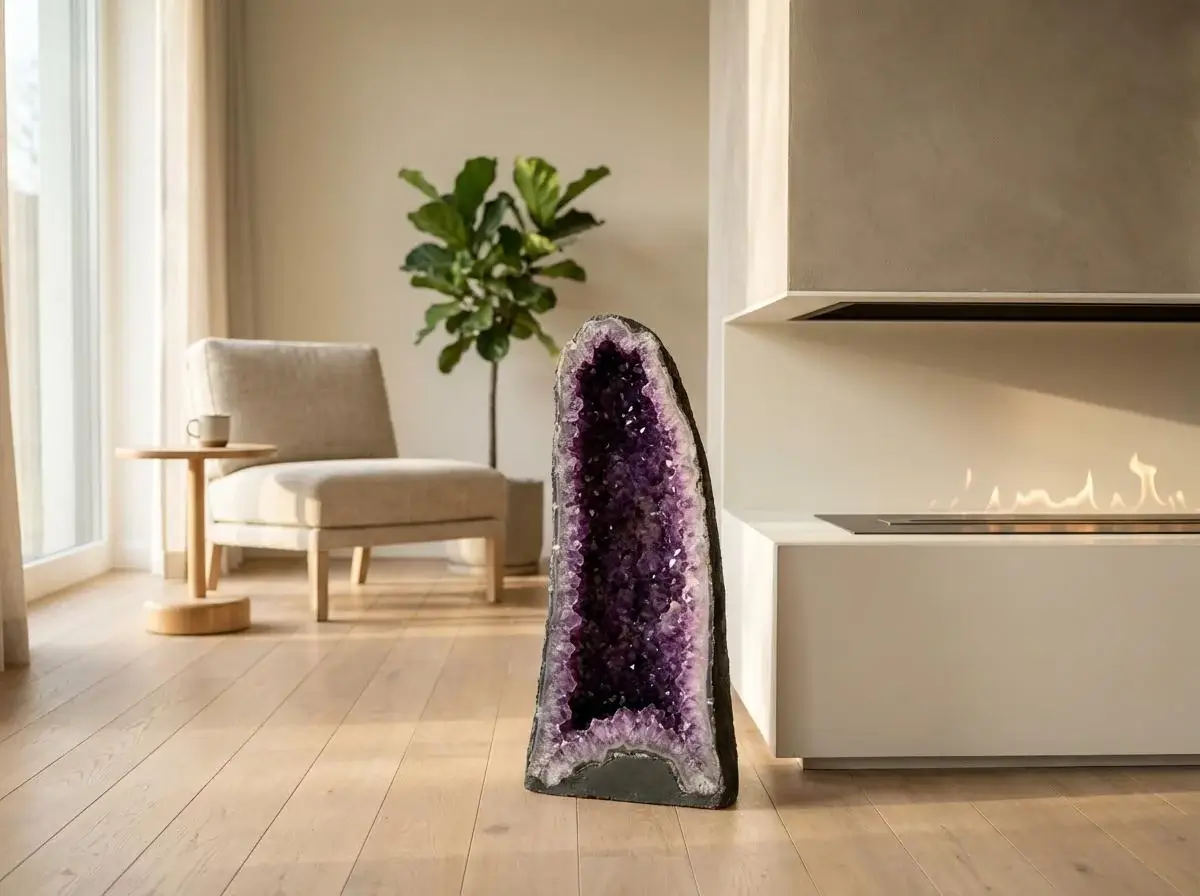
Amethyst geodes work across a wider range of interior styles than most people expect. The organic form and the depth of purple adapt surprisingly well — to spare Scandinavian interiors, to warmer layered spaces, to anything in between.
As a focal point: A taller cathedral geode near a fireplace, console, or lounge chair earns the space immediately. The vertical form guides the eye upward and provides a counterpoint to softer furnishings without fighting them.
Framing an entrance: A slender geode in a hallway sets a tone before anyone has seen the rest of the room. Refined, considered, a little unexpected. Guests notice it, often without knowing exactly why.
Defining a quiet corner: Reading nooks, home offices, meditation spaces — a geode on a stand or low plinth marks the area as intentional. It’s a subtle thing, but it works.
Softening modern lines: In interiors with a lot of glass, metal, and clean geometry, the irregular organic form of a geode introduces warmth without disrupting the aesthetic. It’s the one element that doesn’t follow the grid.
Choosing a specific piece is usually intuitive. Some people want dense, dark violet — the kind of saturation that reads almost black in low light. Others are drawn to lighter lilac tones, broader openings, rounder shapes. There’s no correct answer. What matters is the moment of recognition when you see the right one.
The Quiet Energy of Amethyst Geodes
Amethyst has been associated with clarity and calm for a very long time — the ancient Greeks wore it as a protective stone, and that association has persisted across cultures and centuries in ways that are hard to explain purely as coincidence. I’m honestly not certain what to make of that, and I don’t think I need to be. What I can say is that spending time in front of a good geode tends to do something to your attention. Your gaze slows. The thinking that was running in the background quiets, at least briefly.
You can attribute that to the spiritual properties of amethyst if that framework is meaningful to you. Or you can attribute it to having a naturally beautiful, visually complex object at eye level in a room you spend time in. Either way, the effect seems to hold.
For practical guidance on keeping a geode in good condition — cleaning, placement, how to preserve the colour over years — our amethyst care guide has everything you need.
Frequently Asked Questions
What is an amethyst geode?
An amethyst geode is a hollow stone lined with inward-growing amethyst crystals. It usually forms inside volcanic rock over a very long period of time.
How are amethyst geodes formed?
They form when mineral-rich water enters cavities in volcanic rock and slowly deposits silica. Over time, quartz crystals grow inward, and natural geological conditions help create the purple amethyst colour.
What is the difference between an amethyst geode and a cathedral?
A cathedral is a tall, vertically cut type of geode with a narrower opening and a stronger upright form. Not every geode is a cathedral, but every cathedral is a type of geode.
How do I choose an amethyst geode?
Start with placement, then look at colour, crystal quality, opening shape, and overall balance. The best choice is the one that fits both your space and the feeling you want the piece to bring.
A Curated Selection of One-of-a-Kind Pieces
Every geode in the Saluxe collection is selected individually. Not by catalogue, not by weight category. We look for colour that stops you, shape that feels resolved, and a quality of presence that holds up over years of living with it.
Each piece is photographed on its own before it ships, so what you see in the listing is what arrives at your door. Our current collection is a good place to start if you’re looking for the right one.
Editorial Note — To bring our stories and concepts to life, some images are occasionally artistically refined or digitally composed.
